FAQ
Questions and Answers
Standard
- Why should I clean my solar panel system at all?
Contaminants such as dust, sand, bird droppings, pollen, leaves or industrial deposits can impair the performance of a PV system. Dirt can become permanently embedded in the modules, particularly in the case of solar parks in dusty regions or those situated near roads, railway lines and industrial sites.
Regular professional cleaning removes dirt, maintains performance and enables potential damage to be detected at an early stage.
In short: clean modules are essential to ensuring that your investment remains economically viable in the long term.
- Could Sunbrush damage my solar panels?
No – SunBrush has been specially developed for the gentle cleaning of photovoltaic modules.
A key component is the patented WashTronic technology. It hydraulically regulates the brush contact pressure and automatically compensates for uneven surfaces. This ensures that the brush pressure remains controlled even whilst the machine is in motion.
In addition, the SunBrush brushes have been specially developed for cleaning glass.
- How quickly can I clean a system using SunBrush?
This depends on the system, the level of soiling, the vehicle, the brush width and the cleaning method.
In the case of large solar parks, for example, the SunBrush wet cleaning system can clean up to approximately 12,000 m² per hour – depending on the type and size of the module racks.
This makes SunBrush particularly attractive to professional operators and service providers who wish to clean large areas cost-effectively.
- How is Sunbrush attached to a vehicle?
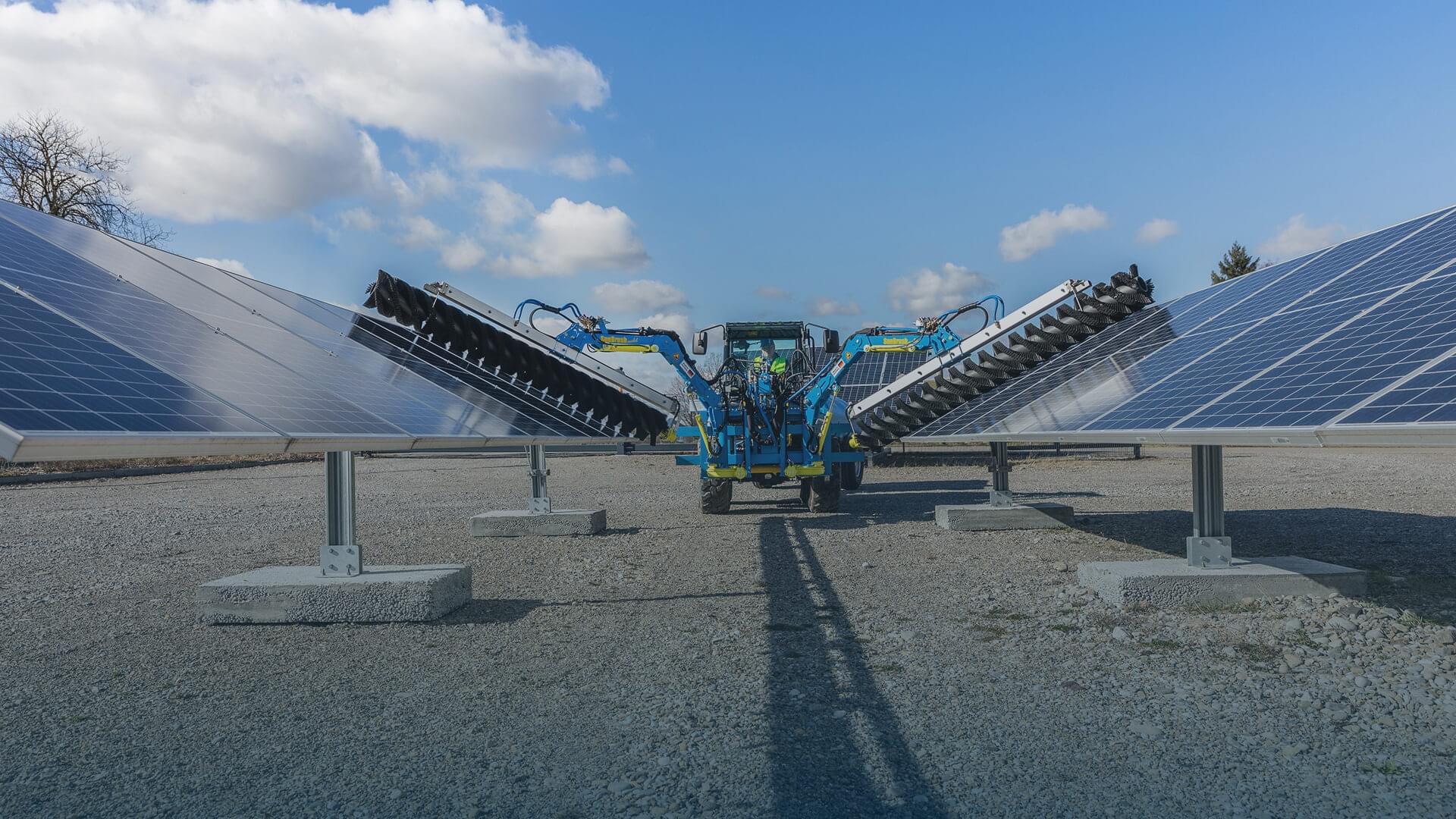
Sunbrush is designed for use with standard carrier vehicles. Depending on the model, the system can be used, for example, with tractors, excavators, telescopic handlers or cranes.
What this means for you is that you do not necessarily need a specialised cleaning vehicle.
Your existing fleet can be turned into a cleaning vehicle.- How long does the installation take?
sunbrush has been designed for quick commissioning.
According to the manufacturer’s specifications, the set-up time for the systems is approximately 3 minutes at most.
This allows you to use your carrier vehicle flexibly for various tasks and, if necessary, convert it at short notice for PV cleaning.
- Can I use Sunbrush for dry cleaning?
Yes.
The Sunbrush systems can be used for both dry cleaning and wet cleaning.
Dry cleaning is particularly suitable for dry dirt such as dust or sand and can reduce water consumption.
For stubborn or encrusted dirt, however, wet cleaning may be the better choice.- Can Sunbrush also remove stubborn dirt such as bird droppings or desert sand?
Yes. Sunbrush has been designed to tackle various types of dirt – including dust, sand, bird droppings, leaves and stubborn deposits.
For particularly stubborn dirt, for example, the Cross Brush is available. For lichen and heavy soiling, the DUO-1000 offers another solution.- How does cleaning with Sunbrush work?
The principle is simple:
The SunBrush system is mounted on the carrier vehicle and controlled via a joystick. The swivelling brush is guided towards the module surface and can be swivelled through 180°.
As the vehicle travels along the rows of modules, the brush carries out the cleaning. This significantly reduces the need for cumbersome manoeuvring between the rows.- Does the driver need to be able to operate a specialised vehicle?
No.
SunBrush is controlled via a joystick and has been designed for simple and precise operation.
The controls allow the brush to be positioned flexibly and adjusted to suit the situation whilst driving.- Does Sunbrush work on uneven ground as well?
Yes – that is exactly what WashTronic was developed for.
Unevenness in the ground may occur during cleaning. The hydraulic contact pressure control automatically adjusts the brush pressure and ensures that the brush rests on the module surface in a controlled manner.
This is a particularly important advantage for ground-mounted systems.- Can I also clean rooftop systems with SunBrush?
Yes.
SunBrush offers a range of solutions for rooftop and ground-mounted systems. For systems located at height or in hard-to-reach places, for example, the Crane variant can be used on a crane or telescopic handler, or our sunbotics cleaning robot.
This means that even the cleaning of challenging rooftop installations can be carried out professionally.- Is Sunbrush only suitable for solar parks?
No.
The systems can be used for a variety of photovoltaic installations – from large solar farms to rooftop systems. Furthermore, the systems can also be used on other smooth surfaces.
Depending on the application, various systems are available, such as Compact, Rapid, TrackFlex, sunbotics or Crane.- Which Sunbrush is right for my system?
That depends on several factors:
- Type of PV system
- Module tilt
- Row spacing
- Terrain
- Height of the system
- Existing carrier vehicle
- Type of contamination
- Desired cleaning performance
That is why sunbrush does not offer a single machine for all applications, but rather a range of systems tailored to different requirements.
Our commitment: We do not simply find any solution for your facility – we find the right one.- Can Sunbrush also clean tracking systems?
Yes.
TrackFlex was developed for tracking PV systems. The system can be used regardless of the modules’ orientation and tilt angle, making it particularly suitable for tracking systems.- How much water does Sunbrush need?
It is also possible to clean without water. However, if water is to be used, this depends on the specific cleaning method and the level of soiling. To ensure the water is used as efficiently as possible, we have designed our system so that we can manage with as little as 0.25 l/m². However, more is always possible.
SunBrush offers a range of water and tank system solutions. For example, water can be fed directly to the cleaning vehicle via a tank system, thereby reducing unnecessary interruptions to the cleaning process.
Dry cleaning can also be used for dry soiling.- Do I need to demineralise my water?
Not necessarily.
Sunbrush Blue is a cleaning agent specially formulated for cleaning solar panels. Depending on the water hardness, the limescale-preventing formula allows a dosage of, for example, 1 litre per 1,000 litres of water.
This helps to reduce the need for complex water treatment.- Can I clean it with warm water?
Yes.
The sunbrush Hot Water system allows preheated water to be used. This can be particularly beneficial when dealing with stubborn dirt and reduces the risk of problematic temperature differences between the cleaning fluid and the module surface.- How often should a solar panel system be cleaned?
There is no one-size-fits-all answer.
The optimal cleaning frequency depends, amongst other things, on the location, climate, degree of soiling, type of installation and surroundings. For example, a solar farm situated next to a busy road, in a desert region or in an agricultural area may become significantly more soiled than a plant in a less polluted environment.
The better question is therefore not ‘How often do I need to clean?’, but ‘When does the next clean make economic sense?’- Is professional solar panel cleaning worth it financially?
In many cases: yes.
Dirt and grime can reduce energy production. At the same time, regular cleaning can help to maintain the condition of the modules and detect dirt and grime at an early stage.
Particularly in the case of large installations, even small percentage losses in yield can have significant financial implications.
Sunbrush turns cleaning into a predictable and professional process.- Is Sunbrush also suitable for desert regions?
Yes – Sunbrush offers specialised solutions specifically for such operating conditions.
Sand and desert dust place particular demands on PV cleaning. Sunbrush can be used for both dry and wet cleaning. The compact Rapid solution, amongst others, was developed for particularly narrow rows of modules and challenging conditions.- Are there any independent tests on gentle cleaning?
Yes.
Among other things, the website refers to a long-term test carried out by the University of Ulm, in which PV modules were contaminated with quartz sand and subsequently cleaned more than 1,000 times using a dry ‘Sunbrush’ system. According to the published test results, no damage to the glass surface or reduction in module performance was observed afterwards.
This is a very strong point for your FAQs, as it backs up the claim that the method is ‘gentle’ with concrete test results.- Why SunBrush and not manual cleaning?
Manual cleaning may be a viable option for small systems. However, with larger PV systems, the time required, labour costs and logistical effort increase rapidly.
Sunbrush automates a large part of the cleaning process and enables professional cleaning whilst the vehicle is in motion. This allows large areas to be cleaned efficiently.- Why should I buy a SunBrush if I already have a tractor?
This is precisely where a key advantage lies: your existing tractor can be turned into a professional PV cleaning vehicle.
Sunbrush can be fitted to standard tractors, excavators or telescopic handlers. This means you do not necessarily need an additional specialised vehicle.- Is Sunbrush only of interest to large companies?
No.
It is not so much the size of your business that matters as the size and number of surfaces to be cleaned. Sunbrush may be of interest to both professional solar cleaning service providers and operators of PV systems.
- What happens if my system has specific requirements?
Sunbrush adopts a modular approach. Depending on the system, a range of machines, brushes, water solutions and accessories are available.
This means that cleaning can, for example, be adapted to narrow rows of modules, tracking systems, tall installations or particularly stubborn dirt.
Customised solutions are also possible, as we have our own R&D department where we work closely with customers to develop solutions that keep pace with market trends.